

Should Religious Liberty Allow Me To Refuse Service To Gay People?
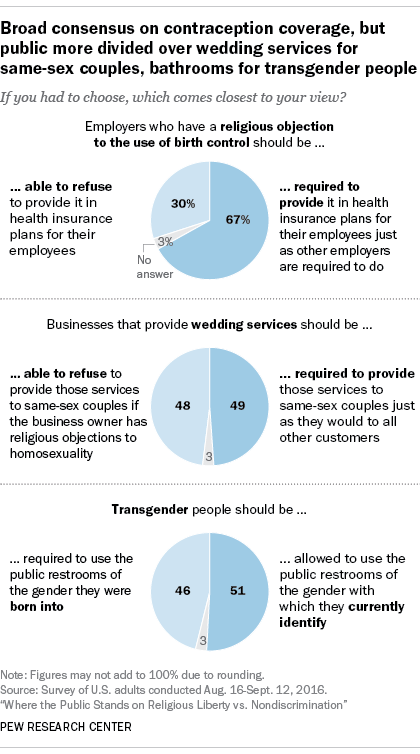 The U.S. public expresses a clear consensus on the contentious question of whether employers who have religious objections to contraception should exist required to provide information technology in health insurance plans for their employees. Fully two-thirds of American adults say such businesses should exist required to cover birth control every bit part of their employees' insurance plans, co-ordinate to a new Pew Research Eye survey, while only three-in-ten say businesses should exist immune to refuse to cover contraception for religious reasons.
The survey of more than 4,500 U.S. adults explores contempo controversies that have pitted claims of religious liberty and traditional morality confronting civil rights and nondiscrimination policies. And information technology finds that Americans are more than closely divided on two other hotly debated questions: whether businesses should be able to refuse service to same-sex couples, and whether transgender people should be required to use item restrooms.
About half of U.Due south. adults (49%) say businesses that provide hymeneals services, such as catering or flowers, should be required to provide those services to same-sex couples as they would for whatsoever other couple. Just a almost equal share (48%) say businesses should be able to refuse services to same-sex couples if the business owner has religious objections to homosexuality.
And in the argue over bathroom employ by transgender people, roughly half of Americans (51%) say transgender people should exist allowed to apply public restrooms of the gender with which they currently place, while nearly as many (46%) say transgender individuals should exist required to use restrooms of the gender they were built-in into.1
The U.Southward. public appears polarized on these debates, just every bit it is on many other aspects of American politics. I of the goals of the survey was to meet how many Americans feel torn because they tin can understand where both sides are coming from on these issues. The brusque answer is: not many.
Before beingness asked to country which position is closest to their own, respondents were asked how much, if at all, they understand with the arguments on either side of an issue. (For full question wording, encounter topline.)
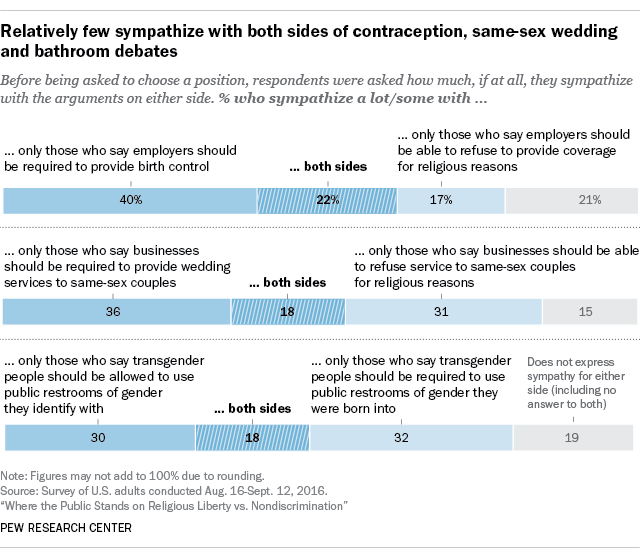
Relatively few took the opportunity to express at least some sympathy for both sides. For example, only over a tertiary of U.S. adults sympathize only with those who say businesses that provide wedding services should be required to provide them to same-sex couples as they would to whatever other customers, and 31% understand merely with those who say businesses should be able to refuse services to same-sex couples if the concern owner has a religious objection. Just 18% say they have at least some sympathy for both sides, while an additional 15% sympathize with neither side.
Similarly, three-in-x Americans sympathize only with those who say transgender people should be allowed to use public restrooms of the gender with which they place, and a similar share sympathize merely with those who say transgender people should be required to use public restrooms of the gender they were born into. Again, eighteen% say they can see where both sides are coming from.
These are among the main findings of a new Pew Research Center survey of iv,538 adults conducted between Aug. 16 and Sept. 12, 2016. The survey was administered online and by mail service among a nationally representative sample. For more details, run into the methodology.
 The widespread support for requiring employers to comprehend birth control in wellness insurance plans may reflect, in function, the fact that very few Americans think that using contraception is morally objectionable. More than 9-in-ten adults think using birth control is either morally acceptable (36%) or not a moral issue at all (57%); only 4% say using contraception is morally wrong.
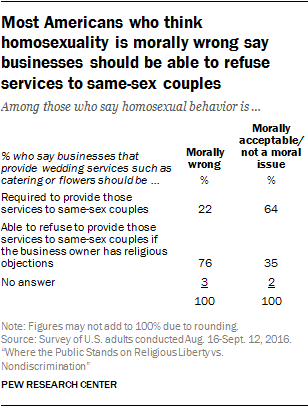
Americans are much more conflicted, however, about the morality of homosexual behavior. While nigh say homosexual behavior is either morally adequate (17%) or not a moral issue (45%), about a third of U.S. adults (35%) believe it is morally wrong. And among those who say homosexual beliefs is morally wrong, a large majority (76%) also say businesses that provide wedding services should be able to refuse to serve aforementioned-sex couples if the business concern owner has religious objections.
A annotation on question wording
Advocates accept often framed the issues covered in this written report as matters of religious liberty or traditional morality on the one hand, or every bit matters of discrimination or civil rights on the other. The question wording in this survey did not adopt either of these approaches. Rather, respondents were given three different scenarios, posing 2 possible sides of each issue. Respondents were asked how much they might sympathize with either side, providing an opportunity to express some ambiguity about these complex issues. Then, respondents were asked which of the two sides comes closest to their own view.
For example, on the effect of whether businesses that provide wedding services should be able to refuse to provide them to same-sex couples if the business organisation owner has religious objections to homosexuality, respondents were presented with the vignette below, followed by iii questions on the matter (run into topline questionnaire for verbal question wording, including randomizations of phrases and question order).
As you may know, same-sexual activity marriage is at present legal in all l states. Some argue that businesses that provide wedding ceremony-related services, such as catering or flowers, should be able to reject to provide those services to aforementioned-sex couples if the business possessor has religious objections to homosexuality. Others argue that businesses that provide wedding-related services should be required to provide those services to same-sex couples just every bit they would to all other customers. We're interested in your views virtually this situation.
Question 1: How much, if at all, practise you sympathize with those who say businesses should exist able to refuse to provide services to same-sexual activity couples if the business concern owner has religious objections to homosexuality? A lot, some, not much or not at all?
Question ii: How much, if at all, do yous understand with those who say businesses should be required to provide services to same-sex couples only every bit they would to all other customers? A lot, some, not much or not at all?
Question 3: And if you had to choose, which comes closest to your view? Businesses that provide wedding services, such as catering or flowers should exist: able to reject to provide those services to same-sex couples if the business organization possessor has religious objections to homosexuality, OR required to provide those services to aforementioned-sexual activity couples only every bit they would to all other customers?
Religious and political differences
When it comes to views about employer-provided nascence command, services for same-sex weddings and use of public restrooms past transgender people, there are big differences betwixt some religious groups. White evangelical Protestants tend to say businesses that provide wedding services should be allowed to turn away same-sex couples and that transgender people should be required to use the public restroom of the gender they were born into. And roughly half of white evangelical Protestants say employers should be allowed to reject to provide birth control in health insurance plans for their employees. Most religiously unaffiliated Americans (i.e., those who place as atheists or agnostics or draw their religion as "nothing in particular") and Jews take the opposite views on these three issues. Black Protestants and Catholics tend to be closely divided on these questions – with the exception of employer-provided contraception coverage. Majorities in each group believe employers should exist required to provide contraception in health care plans for their employees.
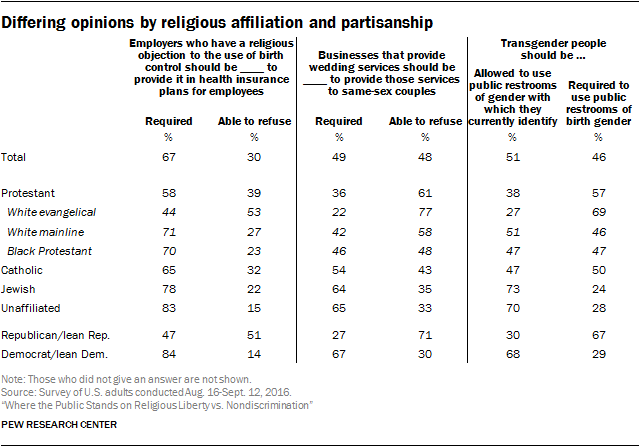
In that location besides are sharp partisan divides on these questions. While more than 8-in-ten Americans who identify with or lean toward the Democratic Party say employers should be required to provide contraception coverage in health insurance plans for employees, Republicans and those who lean toward the GOP are more evenly divided, with 51% maxim employers who have religious objections to the use of birth command should be able to reject to provide it. And while ii-thirds of Democrats say businesses that provide wedding services should exist required to serve aforementioned-sex couples and that transgender people should be allowed to use public restrooms that match their gender identity, majorities of Republicans take the reverse views on these issues.
Most Americans know someone who is gay or lesbian, fewer know someone who is transgender
 A large bulk of Americans (87%) say they personally know someone who is gay or lesbian. A much smaller share – just 3-in-ten – personally know someone who is transgender.2
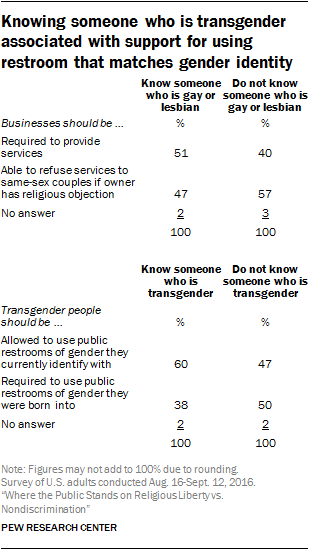
Much like the general public overall, Americans who personally know someone who is gay are closely divided over whether nuptials-related businesses should be required to provide services to same-sex couples. Those who practice not know anyone who is gay are somewhat more likely to say businesses should be able to reject services to aforementioned-sex activity couples if the business organisation possessor has religious objections.
Knowing someone who is transgender is closely linked with views on the use of public restrooms. Most people who personally know someone who is transgender say that transgender people should be allowed to use public restrooms that friction match their current gender identity (lx%). Americans who do not know any transgender people, by contrast, are more than evenly divided as to whether transgender people should be allowed to utilise the restrooms of their gender identity (47%) or required to use the restrooms of their nativity gender (fifty%).
Some of the survey's other key findings include:
- I-in-v U.S. adults say their views on homosexuality take changed over the past few years, and most say they have become more accepting. Among the almost mutual reasons given for changing viewpoints are having a friend or family unit member who is gay or lesbian and coming to the belief that people are free to live their lives nonetheless they choose.
- Women are more than likely than men to say employers should exist required to embrace birth control in the health intendance plans they offer employees (72% vs. 62%). Women are also more probable than men to say that wedding ceremony-related businesses should be required to serve same-sexual practice couples despite religious objections (54% vs. 44%) and that transgender people should be able to use restrooms that match the gender with which they place (55% vs. 45%).
- U.Southward. adults under age 30 differ from older Americans in their views regarding bathroom utilise by transgender people: Two-thirds of those ages 18 to 29 say transgender people should be allowed to use public restrooms matching their current gender identity, while Americans over xxx are much more divided. Young adults also are more probable than their elders to say employers should be required to provide contraception coverage in wellness care plans and that businesses should be required to provide services to aforementioned-sex couples.

Should Religious Liberty Allow Me To Refuse Service To Gay People?,
Source: https://www.pewresearch.org/religion/2016/09/28/where-the-public-stands-on-religious-liberty-vs-nondiscrimination/
Posted by: brauertiousbactine.blogspot.com
0 Response to "Should Religious Liberty Allow Me To Refuse Service To Gay People?"
Post a Comment